

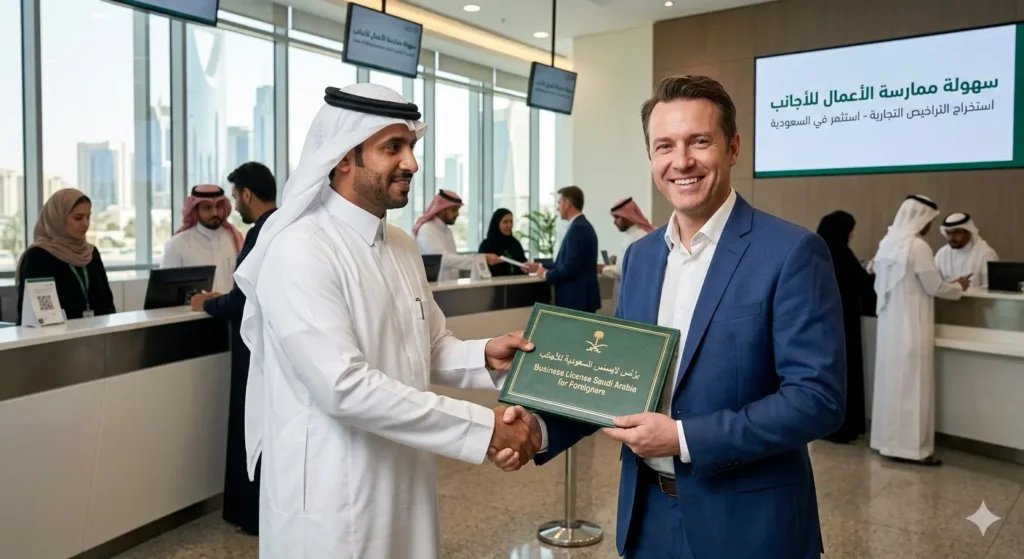
Saudi Arabia has transformed into one of the world’s most dynamic investment destinations. Under Vision 2030, the Kingdom has opened its doors to global investors, offering unprecedented access to a $1.1 trillion economy and strategic regional positioning . Whether you are an entrepreneur from the United States, a tech firm from India, or a manufacturing giant from China, understanding the licensing framework is the first critical step.
As of 2026, the Saudi regulatory environment prioritizes transparency and speed, but it is also highly structured. This guide provides a detailed breakdown of the licenses, requirements, and strategic considerations for foreigners looking to establish a presence in the Kingdom, with special notes for GCC nationals where applicable.
What is a Business License Saudi Arabia for Foreigners?
For a foreigner (non-GCC), a Business License is not one single document. It is a two-step legal approval:
- MISA License – The investment permit from the Ministry of Investment of Saudi Arabia. This gives you permission to invest as a foreigner.
- Commercial Registration (CR) – The company identity card from the Ministry of Commerce. This allows you to legally trade, hire staff, and open bank accounts.
Simple rule: MISA License = “You may invest” | CR = “You exist as a company”
Do You Need a Business License as a Foreigner?
Yes, 100% of the time. Without both the MISA License and the CR, you cannot:
- Sign leases or contracts
- Hire employees (Saudi or foreign)
- Open a corporate bank account
- Import or export goods
- Pay or receive invoices legally
“While selecting the right license is crucial, understanding the full financial picture is equally important. You can check our detailed guide on the [Cost of opening a company in Saudi Arabia] for a complete 2026 budget breakdown.”
MISA License vs. Commercial Registration: The “Permission” vs. The “Identity”
One of the most common points of confusion for foreign investors is distinguishing between the MISA License and the Commercial Registration (CR) . In simple terms, if you are a foreigner, the MISA license is your “permission to invest,” while the CR is your company’s “legal identity” or “birth certificate” . You cannot trade, sign contracts, or open a bank account with only a MISA license; you need the CR to activate the entity .
For non-GCC (Gulf Cooperation Council) investors—including those from the US, UK, China, and the rest of the world—the MISA license is mandatory and must be obtained before applying for the CR . The Ministry of Investment of Saudi Arabia (MISA) vets the foreign entity to ensure legitimacy and alignment with national economic goals. Once approved, you proceed to the Ministry of Commerce to obtain the CR, which registers your trade name, legal structure (LLC, Branch, etc.), and specific business activities . This sequential process ensures that foreign capital is regulated before it enters the local commercial registry.
Note for GCC Nationals: Investors from GCC countries (UAE, Kuwait, Qatar, Bahrain, Oman) are generally treated like Saudi nationals. In most sectors, they do not require a MISA license and can proceed directly to obtain the Commercial Registration (CR) . However, regulated industries may still require specific approvals.
“If you are a solo entrepreneur, you might want to explore the benefits of a One person company in Saudi Arabia], which offers a simplified structure for single shareholders.”
Types of Business Licenses for Foreigners
Choosing the correct license type is the core of your market entry strategy. MISA issues distinct categories based on the nature of the economic activity . Below are the primary license types available to foreigners in 2026, reflecting 100% ownership allowances in most sectors.
1. Service License
This is the most common entry point for international businesses. It covers non-trading, non-manufacturing activities such as IT services, management consulting, marketing agencies, education, and healthcare . The minimum capital requirement is relatively low (starting at SAR 25,000), making it accessible for SMEs. However, specific sub-sectors like healthcare require additional approvals from the relevant ministry (e.g., Ministry of Health) .
2. Commercial (Trading) License
This license allows foreign entities to engage in wholesale, retail trade, import, and distribution within the Saudi market . Due to the direct access to the consumer market, this license carries significantly higher capital requirements. For 100% foreign ownership, the minimum capital is SAR 30 million (approx. $8 million), often requiring proof of operations in three or more countries and a multi-year investment commitment . A more accessible route involves a joint venture with a 25% Saudi partner, reducing the foreign capital contribution.
3. Industrial License
For manufacturing and processing activities, the Industrial License is required. This is regulated jointly by MISA and the Ministry of Industry and Mineral Resources . Given Saudi Arabia’s focus on local manufacturing, this sector offers high incentives, including financing from the Saudi Industrial Development Fund (SIDF) and customs exemptions on machinery. The minimum capital is higher, starting at SAR 500,000, and requires a detailed feasibility study and factory location (often in MODON cities) .
4. Real Estate License
This license targets large-scale property development rather than individual property purchases. It allows foreign developers to undertake residential or commercial projects . The key requirement is a minimum project value of SAR 30 million ($8 million), and activities are restricted outside the holy cities of Mecca and Medina . As of January 2026, foreign investors are also legally permitted to own real estate for commercial purposes, adding a new layer of opportunity for this sector .
5. Entrepreneurial (Startup) License
Designed for tech startups and innovators, this license offers a more flexible pathway. Instead of demanding years of operational history, it focuses on the business concept, growth potential, and ties to recognized accelerators or VC funds . This license aligns with the Kingdom’s push to become a startup hub, offering reduced capital requirements and access to government support programs via Monsha’at (the SME authority).
6. Professional License
This is for specialized services such as law firms, engineering consultancies, and accounting practices. It often operates under joint supervision with professional regulators (e.g., the Saudi Council of Engineers) . While foreign ownership is possible, many professional firms operate as joint ventures with Saudi partners to meet local licensing requirements for regulated professions.
“The first step for any international investor is securing a [Foreign Investment License in Saudi Arabia], which acts as your gateway to the Kingdom’s economy.”
our Partner in Success: Let Vertexa Handle the Complexity
“Navigating the regulatory landscape in a new country can be overwhelming, but you don’t have to do it alone. At Vertexa, we take the entire burden off your shoulders. From securing your MISA license to final tax registrations, our experts manage every single detail of your setup journey. We don’t just provide services; we provide peace of mind. Book your free consultation today and discover how we turn complex government procedures into a seamless, turnkey experience for your business.”
Activity-Specific Licenses: Sectoral Approvals
Holding a MISA license does not automatically grant you the right to operate in regulated industries. Depending on your business activity, you must secure additional approvals from sector-specific government bodies before you can legally commence operations . These are not alternatives to the MISA license but mandatory add-ons.
- Tourism & Hospitality: If you plan to operate a hotel, travel agency, or tourist transport, you need a license from the Ministry of Tourism. This often includes specific quality standards and facility classifications .
- Healthcare: Any pharmaceutical, medical device, or private clinic operation requires approval from the Saudi Food and Drug Authority (SFDA) . Pre-approval fees for medical products can exceed SAR 20,000, and the process involves strict technical evaluations .
- Food & Beverage: Restaurants and food importers must secure Municipality Licenses (Baladiya) for health and safety inspections. Additionally, halal certification from approved bodies is mandatory, costing between SAR 15,000 and 50,000 depending on the product scope .
- Professional Services: Engineering and legal firms need certifications from their respective professional councils (e.g., Saudi Council of Engineers) to validate the qualifications of their staff .
Failure to secure these “Activity-Specific Licenses” can result in operational shutdowns, even if your Commercial Registration is active. Investors should identify these requirements during the business planning phase to avoid delays.
Minimum Requirements for Each License Type
While financial capital is a key metric, the “Minimum Requirements” also include technical documentation and operational history. The table below summarizes the core technical requirements for the main license types as of 2026 .
| License Type | Minimum Capital | Key Technical Requirements | Saudization (Nitaqat) |
|---|---|---|---|
| Service | SAR 25,000 | 1+ year parent company history; Audited financials; Business plan. | 25-30% of workforce |
| Commercial | SAR 30 million (100% ownership) | Operations in 3+ countries; Investment commitment letter. | Varies (Retail focused) |
| Industrial | SAR 500,000 | Feasibility study; Factory layout; Environmental impact assessment. | Up to 40% |
| Real Estate | SAR 30 million (Project value) | Proof of prior development (3+ projects); Audited statements. | Project-specific |
| Entrepreneurial | Variable (Lower) | Incubator/Accelerator backing; Pitch deck; Founder CVs. | Reduced initial quotas |
Beyond capital, all foreign applicants must provide a Board Resolution from the parent company authorizing the subsidiary, Passport copies of all shareholders, and Articles of Association (translated into Arabic and notarized) . For the Commercial License (Trading), the technical requirement shifts from capital to “footprint”—MISA wants to see that you are a global player bringing value to the local distribution network .
Validity and Renewal of Saudi Business Licenses
Obtaining your license is not a one-time event. Saudi Arabia operates on an annual renewal cycle to ensure ongoing compliance with tax laws, Saudization quotas, and operational standards . Missing renewal deadlines can lead to automatic suspension of your Commercial Registration (CR), visa blocks, and banking freezes .
- Validity Period: Both the MISA License and the Commercial Registration (CR) are typically valid for one year from the date of issuance .
- The Renewal Process: Renewals must be completed before the expiry date via the respective digital portals (Invest Saudi for MISA, Ministry of Commerce for CR). The process requires updated financial statements, proof of Saudization compliance (via the Qiwa platform), and payment of government fees .
- Key Costs for Renewal (2026):
- CR Renewal: Approximately SAR 1,200 per year .
- Chamber of Commerce: Sliding scale based on capital/employees, ranging from SAR 200 to SAR 5,000 .
- MISA License: Important Update for 2026: While previous years had a “Year 2 shock” where fees jumped to SAR 62,000, current guidance suggests issuance fees have been suspended until further notice to support investors. However, standard renewal fees (approx. SAR 2,000) still apply . Always verify current fees on the MISA portal.
- Work Permits (Iqama): Renewing residency for foreign employees costs approximately SAR 9,700 annually per employee, plus medical insurance (SAR 1,500 – 5,000) .
Ongoing Compliance: Beyond the License
Securing the license is just the beginning. Foreign businesses face significant ongoing compliance costs that are often underestimated. To operate legally in 2026, you must register with several authorities immediately after receiving your CR .
- ZATCA (Tax Registration): You must register with the Zakat, Tax and Customs Authority. Foreign companies pay 20% Corporate Income Tax on profits and 15% Value Added Tax (VAT) if revenue exceeds SAR 375,000 . Mandatory e-invoicing (Phase 2) with QR codes is now strictly enforced .
- GOSI (Social Insurance): Every employee, Saudi or foreign, must be registered with the General Organization for Social Insurance. Contributions are deducted monthly .
- Qiwa & Saudization: You must manage your workforce quota via the Qiwa platform. If your Saudization percentage (Nitaqat) falls below the threshold for your sector (e.g., 30% for engineering), you cannot renew visas or apply for new work permits .
Planning for these recurring operational expenses is just as critical as raising the initial setup capital. Companies that fail to budget for these “hidden” costs often face cash flow crises within the first six months of operation.
Conclusion
The Saudi Arabian market in 2026 offers unparalleled opportunities for foreign investors, characterized by streamlined digital processes and broad allowance for 100% ownership. Whether you are a solo entrepreneur applying for a Service License or a multinational seeking a Commercial License, the pathway is clear: secure the MISA permission, obtain the CR identity, and then adhere to sector-specific rules. By understanding the distinct roles of each document and preparing for the annual renewal cycle, you can successfully establish and scale your business in the Kingdom.